

History of Marrakech: a thousand-year-old city at the heart of Moroccan history
The history of Marrakech is the story of a city that has crossed the centuries without losing its identity. Founded in the 11th century, it established itself as a political capital, a commercial crossroads, a spiritual center, an artistic home, and a symbol of Morocco. Even today, its name evokes historical power, architectural richness, and the intensity of a unique art of living.
Understanding the history of Marrakech means going beyond the city’s touristic image. It means discovering how its ramparts, medina, major monuments, gardens, neighborhoods, and reputation were built. It also means understanding why Marrakech has held such an important place in both Moroccan and international imagination.
The history of Marrakech is not linear. It is made of foundations, conquests, periods of influence, transformations, times of brilliance, and moments of renewal. This complexity gives the city a particular density. It is not a frozen setting, but a historical city that remains fully alive.
The founding of Marrakech in the 11th century
The history of Marrakech begins in the 11th century with the founding of the city by the Almoravids. The choice of location was far from accidental. Marrakech stood at the meeting point of several dynamics: the proximity of the Atlas Mountains, the opening toward the south and the Sahara, the trade routes, and the possibility of creating a center of power in a strategic region.
From the start, the city was conceived as a place of authority and influence. Its foundation marked a major stage in Moroccan history. Marrakech was not simply a new urban center, but a political project. That helps explain how quickly it gained importance.
The Almoravids, builders of the first Marrakech
The Almoravids play a fundamental role in the history of Marrakech. They founded the city and gave it its first political and urban impulse. Their period laid the foundations for future development.
Under their influence, Marrakech became a major center for both power and exchange. It attracted populations, merchants, artisans, and men of learning. Even if many of the earliest constructions have disappeared or been transformed, the Almoravid imprint remains decisive in the city’s memory.
The Almohads and monumental affirmation
An essential stage in the history of Marrakech corresponds to the Almohad period. Under this dynasty, the city asserted its power even more strongly. The Almohads reinforced Marrakech’s political and spiritual status and left durable monuments that still shape the city’s landscape today.
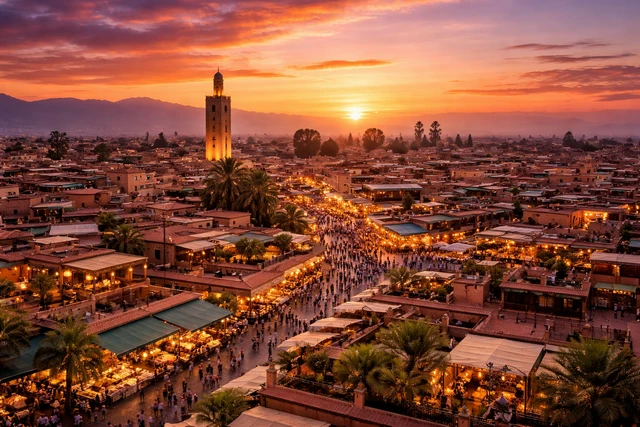
The Koutoubia, for instance, bears witness to this ambition. Its minaret became one of the strongest symbols of the city. This period also deepened the relationship between power, religion, and architecture. Marrakech then entered a dynamic of prestige that extended far beyond its immediate territory.
Marrakech as a commercial and cultural crossroads
The history of Marrakech cannot be understood without considering its commercial role. For centuries, the city served as a crossroads between north and south, between desert routes, inland regions, and wider exchange networks. This strategic position nourished both its economic and cultural development.
Markets, caravans, goods, influences, and movements shaped the identity of Marrakech. The city was built through motion, exchange, and encounter. This helps explain its ability to absorb different influences while preserving a strong cultural coherence.
Dynasties and the construction of Marrakech’s prestige
Several dynasties left their mark on the history of Marrakech. Each contributed to urban planning, architecture, institutions, and the image of the city. Some made Marrakech a major political capital. Others strengthened its artistic, spiritual, or symbolic prestige.
The succession of dynasties did not transform the city only on the material level. It also enriched its narrative. Even today, visiting Marrakech means moving through layers of superimposed history. A gate, a wall, a palace, a school, or a garden may refer to different but complementary periods.
The Saadians and the age of refinement
The Saadian period holds a special place in the history of Marrakech. It is often associated with a form of artistic and monumental peak. The Saadian Tombs, El Badi Palace, and other traces of that era testify to a taste for splendor, the staging of power, and decorative sophistication.
Marrakech became a city of prestige. It attracted attention, impressed visitors, and asserted its strength. This period powerfully contributed to the image of refinement that the city still preserves today.
The medina, living memory of the history of Marrakech
The history of Marrakech remains legible in its medina. The alleys, squares, souks, neighborhoods, and ramparts preserve the structure of an old urban world. This continuity is precious. It allows the past to be approached not only through isolated monuments, but through an inhabited urban fabric.
The medina is a living memory. It carries traces of the city’s social, commercial, and religious organization. It shows how history became inscribed within everyday space.
The ramparts, markers of the historical city
The ramparts occupy an important place in the history of Marrakech. They remind us that the city was conceived as a protected, organized, and representative entity. Their ochre color, their length, and their constant presence give Marrakech a very strong visual identity.
They also create a symbolic boundary between different experiences of the city. Inside, the medina retains a more direct relationship to history. Outside, other forms of urban development gradually took shape.
Marrakech through the centuries: continuity and transformation
The history of Marrakech is made of continuity, but also of transformation. The city experienced periods of political domination, phases of relative decline, moments of restoration, and waves of renewal. Yet it always preserved a strong capacity for influence.
This resilience partly explains the strength of its current image. Marrakech did not merely survive history; it learned to turn history into a resource. Its heritage, culture, know-how, and atmosphere continue to nourish its vitality.
Modern Marrakech and international influence
Today, the history of Marrakech extends into a new phase. The city has become an internationally influential destination, a place of creation, hospitality, events, and inspiration. Yet its contemporary attractiveness rests largely on the historical depth it has managed to preserve.
Marrakech does not attract visitors despite its past, but because of it. Travelers come looking for a city with memory, aesthetics, stories, and cultural density. The history of Marrakech therefore remains at the heart of its present.
Why does the history of Marrakech fascinate so much?
The history of Marrakech fascinates because it concentrates several powerful dimensions: the founding of a great city, the role of dynasties, the beauty of heritage, the importance of trade, the strength of tradition, and the continuity of an art of living. Few cities offer such a clear impression of historical depth while remaining so intensely alive.
It also fascinates because it allows Morocco to be read through one city. Marrakech becomes a prism through which broader political, cultural, religious, and aesthetic dynamics can be understood.
The history of Marrakech in the traveler’s experience
For the traveler, knowing the history of Marrakech profoundly changes the way the city is perceived. The ramparts are no longer simply beautiful; they become meaningful. Monuments are no longer only impressive; they take their place within a chronology. Even the souks appear as the legacy of a long commercial tradition.
This knowledge enriches the journey. It gives the stay a deeper, more sensitive, and more memorable dimension.
Conclusion
The history of Marrakech is the story of a founding, prestigious, resilient, and ever-radiant city. From its birth in the 11th century to its status as a major international destination, Marrakech has preserved a powerful identity. Discovering the history of Marrakech means understanding why the Red City continues to fascinate. It also means realizing how strongly its past still lives within its walls, streets, monuments, and unique atmosphere.