

The Monuments of Marrakech: historical and architectural treasures of the Red City
The monuments of Marrakech tell the story of one of Morocco’s great cities, shaped by dynasties, power, spirituality, art, and refinement. They are not simply beautiful places to photograph. They are visible traces of a prestigious past and offer visitors a concrete reading of the city’s evolution. By discovering them, one better understands why Marrakech fascinates so deeply.
The Red City holds an exceptional heritage. Behind the ramparts, around a corner, along major axes as well as in quieter places, the monuments of Marrakech recall the historical, political, and cultural importance of the city. They reveal an ongoing dialogue between architecture, aesthetics, and ways of life. One finds a taste for patios, gardens, balanced proportions, intricate decoration, and the art of creating beauty in spaces designed to endure.
Visiting the monuments of Marrakech means entering a city that has preserved an essential part of its soul. It also means understanding how heritage still shapes its identity, its appeal, and its international influence today.
Why are the monuments of Marrakech so important?
The monuments of Marrakech are important because they embody several centuries of Moroccan history. They make it possible to follow the influence of the great dynasties that marked the city and to observe how architecture adapted to the political, religious, and cultural ambitions of each period.
They are also precious because they have endured through time. Some have been restored, while others still show the marks of age, yet all preserve a strong symbolic force. Their presence structures the urban landscape and nourishes the relationship that residents maintain with their own history.
Finally, the monuments of Marrakech matter because they offer a singular aesthetic experience. The city often develops an architecture where sober exteriors conceal extraordinary interior refinement. This tension between discretion and splendor is part of the magic of Marrakech’s heritage.
The Koutoubia, a major symbol of Marrakech
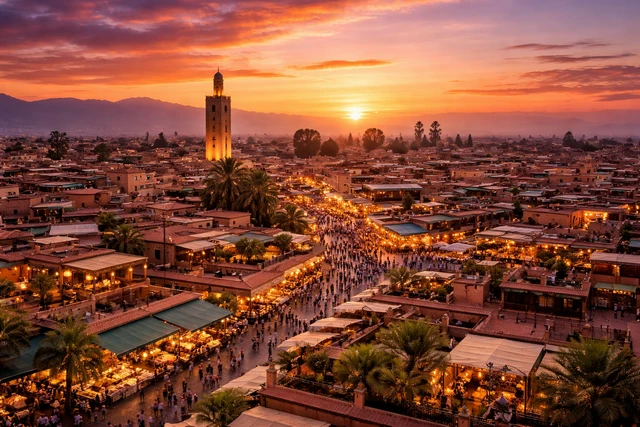
Among the monuments of Marrakech, the Koutoubia Mosque occupies a completely central place. Its majestic minaret dominates the city and serves as a visual landmark across many neighborhoods. The Koutoubia is one of the best-known symbols of Marrakech and certainly one of the most photographed.
Beyond its religious significance, it represents a decisive stage in the city’s development. Its architecture, sober, balanced, and powerful, reflects the genius of builders who gave Marrakech monumental lines without excessive heaviness. The Koutoubia is not only a monument; it is a presence. It shapes the skyline of Marrakech and constantly reminds visitors of the city’s historical depth.
Bahia Palace, refinement and elegance
Bahia Palace is one of the most admired monuments of Marrakech. From the moment one enters, the harmony of the courtyards, the richness of the ceilings, the delicacy of the decorations, and the quality of the materials make a strong impression. This palace allows visitors to understand the art of living in grand Moroccan residences and the taste for spaces that are both majestic and intimate.
The rooms, gardens, and patios show how Moroccan architecture works with light, shadow, airflow, and the relationship between inside and outside. Bahia Palace also illustrates the importance of decoration as a language. Painted wood, zellige, marble, carved stucco, and gardens create an ensemble of remarkable elegance.
Ben Youssef Madrasa, a masterpiece of learned architecture
The Ben Youssef Madrasa is another key element among the monuments of Marrakech. This former Quranic school impresses through the beauty of its central courtyard, the balance of its architectural composition, and the precision of its ornamentation.
This place reminds us that Marrakech was not only a city of trade and power, but also an intellectual and spiritual center. The madrasa reflects a history in which education, religion, and architecture were closely connected. Visitors often feel here a different atmosphere from that of the palaces: more contemplative, more geometric, and more oriented toward order and transmission.
The Saadian Tombs, memory of a dynasty
The Saadian Tombs rank among the most fascinating monuments of Marrakech. They offer access to a dynastic history marked by prestige, refinement, and the desire to leave a monumental legacy. The atmosphere is distinctive, suspended between memory, decorative beauty, and the feeling of crossing a place long protected from time.
The work of materials, the finesse of the decorations, and the solemnity of the space intensify the emotion of the visit. The Saadian Tombs reveal the way power expressed itself through funerary architecture and through the staging of dynastic continuity.
El Badi Palace, grandeur and majestic ruin
El Badi Palace offers a very different experience. Among the monuments of Marrakech, it stands out because of its scale, the sense of openness it creates, and the force of its ruins. Here, the visitor is not only facing an intact monument, but also the remains of former splendor. This adds a particular emotion.
El Badi Palace reminds us that Marrakech once experienced periods of spectacular power. Even in its current state, it retains something monumental. It invites visitors to imagine former grandeur and to approach the city through the lenses of power, representation, and architectural ambition.
The ramparts and historic gates
People sometimes forget that the monuments of Marrakech are not limited to palaces and famous sites. The ramparts themselves are part of the city’s monumental heritage. Their color, continuity, and structuring presence recall the old defensive and symbolic role of the city.
The historic gates reinforce this impression. They do not simply serve as points of passage. They mark thresholds, hierarchies, and entrances into an organized urban world. They fully contribute to the monumentality of Marrakech.
The architecture of the monuments of Marrakech
The architecture of the monuments of Marrakech is characterized by a subtle balance between strength and finesse. The volumes are often sober from the outside, yet the interiors reveal extraordinary decorative richness. This logic corresponds to a conception of space deeply rooted in Moroccan culture.
Central patios, fountains, gardens, arches, painted ceilings, woodwork, carved stucco, and mosaics all form a coherent architectural language. Light plays an essential role. It moves across surfaces, animates reliefs, and transforms the experience according to the time of day.
The monuments of Marrakech also show the importance of freshness, shade, water, and gardens in spatial design. Aesthetics is never fully disconnected from climatic comfort and from the relationship to life and nature.
The role of monuments in the traveler’s experience
For a traveler, the monuments of Marrakech are much more than a series of sites to check off. They give depth to the stay. They allow visitors to move beyond a purely visual or decorative perception of the city and enter into a denser understanding of its history.
Visiting a monument also changes the way one sees the rest of Marrakech. After discovering a palace, a madrasa, or a tomb, one reads the alleys, gates, riads, gardens, and even certain details of daily life differently. Heritage creates a context that illuminates the whole city.
How should you organize a visit to the monuments of Marrakech?
It can be wise to spread the visit of the monuments of Marrakech across several moments of a stay. Some sites require time in order to be fully appreciated. It is often preferable to visit early in the morning or later in the afternoon in order to enjoy a softer atmosphere and more beautiful light.
Combining several monuments during the same day makes it possible to understand the contrasts between them: the spirituality of a mosque viewed from outside, the refinement of a palace, the rigor of an old school, the power of a ruined ensemble. This diversity is what makes Marrakech’s heritage so rich.
The monuments of Marrakech and photography
The monuments of Marrakech naturally attract photography lovers. Shadows, architectural lines, decorative details, inner courtyards, gardens, and materials provide an extraordinary visual field. Yet photographing these places can also invite a slower gaze. Some details only reveal themselves through careful attention.
Photography can become a way of seeing better: a symmetry, a zellige pattern, a color, a transparency, the patina of a wall, or the way light enters a patio.
Why do the monuments of Marrakech fascinate so much?
The monuments of Marrakech fascinate because they combine history, beauty, and atmosphere. They are not only impressive because of their age or prestige. They also move people through their ability to make continuity of time perceptible. In these places, the past is not completely frozen. It still feels present.
They also attract because they reveal an art of building deeply linked to a worldview in which beauty, measure, hospitality, spirituality, and the relationship to nature all hold an essential place.
Conclusion
The monuments of Marrakech are among the city’s greatest treasures. They offer visitors a sensitive and concrete reading of its history, refinement, and cultural depth. Discovering the monuments of Marrakech means understanding why the Red City continues to radiate far beyond Morocco. It also means feeling, through stone, wood, water, gardens, and light, everything Marrakech has managed to preserve of its grandeur.